
Classifying Iris Flowers with Deep Learning, Groovy® and GraalVM
Published: 2022-06-25 10:52AM (Last updated: 2026-08-20 10:00AM)
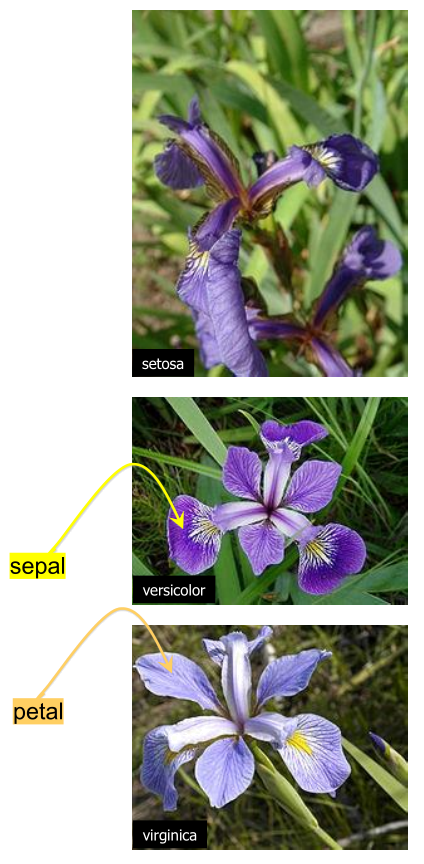 A classic data science dataset captures flower characteristics of Iris flowers.
It captures the width and length of the sepals and petals for three species (Setosa, Versicolor, and Virginica).
A classic data science dataset captures flower characteristics of Iris flowers.
It captures the width and length of the sepals and petals for three species (Setosa, Versicolor, and Virginica).
The Iris project in the groovy-data-science repo is dedicated to this example. It includes a number of Groovy scripts and a Jupyter/BeakerX notebook highlighting this example comparing and contrasting various libraries and various classification algorithms.
| Technologies/libraries covered | |
|---|---|
Data manipulation |
|
Classification |
|
Visualization |
|
Main aspects/algorithms covered |
Reading csv, dataframes, visualization, exploration, naive bayes, logistic regression, knn regression, softmax regression, decision trees, support vector machine |
Other aspects/algorithms covered |
Feel free to browse these other examples and the Jupyter/BeakerX notebook if you are interested in any of these additional techniques.
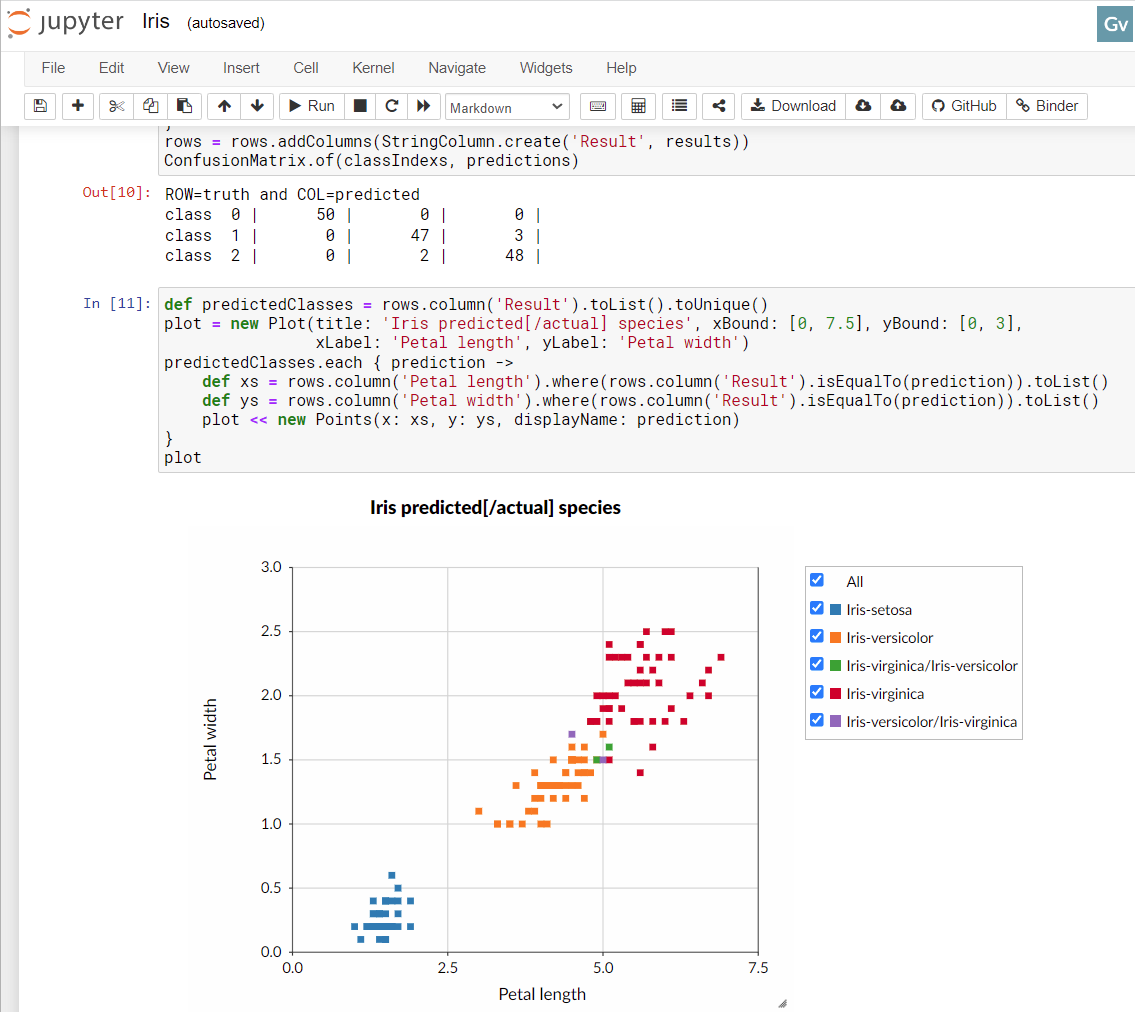
For this blog, let’s just look at the Deep Learning examples. We’ll look at solutions using Encog, Eclipse DeepLearning4J and Deep Netts (with standard Java and as a native image using GraalVM) but first a brief introduction.
Deep Learning
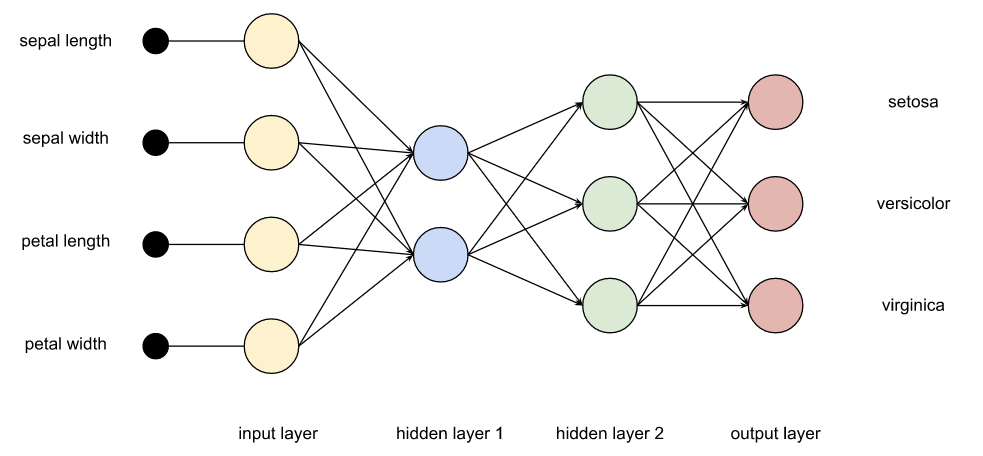
Deep learning falls under the branches of machine learning and artificial intelligence. It involves multiple layers (hence the "deep") of an artificial neural network. There are lots of ways to configure such networks and the details are beyond the scope of this blog post, but we can give some basic details. We will have four input nodes corresponding to the measurements of our four characteristics. We will have three output nodes corresponding to each possible class (species). We will also have one or more additional layers in between.
Each node in this network mimics to some degree a neuron in the human brain. Again, we’ll simplify the details. Each node has multiple inputs, which are given a particular weight, as well as an activation function which will determine whether our node "fires". Training the model is a process which works out what the best weights should be.
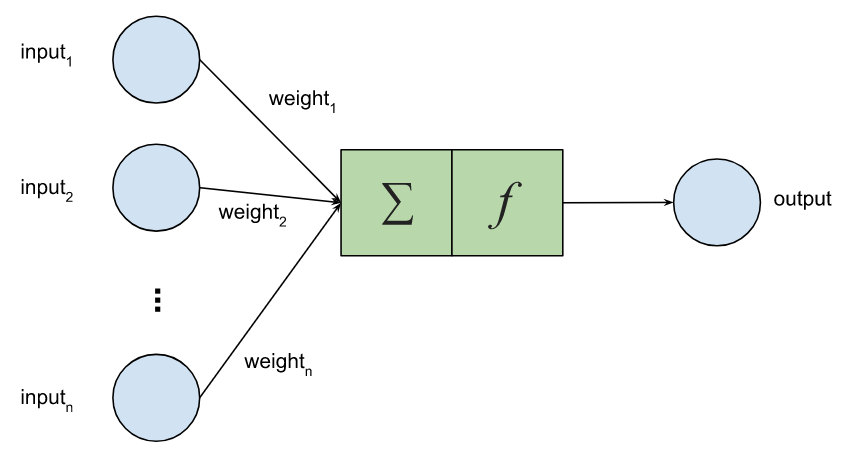
The math involved for converting inputs to output for any node isn’t too hard. We could write it ourselves (as shown here using matrices and Apache Commons Math for a digit recognition example) but luckily we don’t have to. The libraries we are going to use do much of the work for us. They typically provide a fluent API which lets us specify, in a somewhat declarative way, the layers in our network.
Just before exploring our examples, we should pre-warn folks that while we do time running the examples, no attempt was made to rigorously ensure that the examples were identical across the different technologies. The different technologies support slightly different ways to set up their respective network layers. The parameters were tweaked so that when run there was typically at most one or two errors in the validation. Also, the initial parameters for the runs can be set with random or pre-defined seeds. When random ones are used, each run will have slightly different errors. We’d need to do some additional alignment of examples and use a framework like JMH if we wanted to get a more rigorous time comparison between the technologies. Nevertheless, it should give a very rough guide as to the speed to the various technologies. One more caveat since this post was first written: the Encog and DeepLearning4J transcripts below are still the original 2022 runs on a Linux box, while the Deep Netts and GraalVM sections have been re-run on an Apple Silicon machine with Groovy 6.0.0-beta-2 and GraalVM CE 25. Compare numbers within a section, not across them.
Encog
Encog is a pure Java machine learning framework that was created in 2008. There is also a C# port for .Net users. Encog is a simple framework that supports a number of advanced algorithms not found elsewhere but isn’t as widely used as other more recent frameworks.
The complete source code for our Iris classification example using Encog is here, but the critical piece is:
def model = new EncogModel(data).tap {
    selectMethod(data, TYPE_FEEDFORWARD)
    report = new ConsoleStatusReportable()
    data.normalize()
    holdBackValidation(0.3, true, 1001) // test with 30%
    selectTrainingType(data)
}

def bestMethod = model.crossvalidate(5, true) // 5-fold cross-validation

println "Training error: " + pretty(calculateRegressionError(bestMethod, model.trainingDataset))
println "Validation error: " + pretty(calculateRegressionError(bestMethod, model.validationDataset))
When we run the example, we see:
paulk@pop-os:/extra/projects/iris_encog$ time groovy -cp "build/lib/*" IrisEncog.groovy
1/5 : Fold #1
1/5 : Fold #1/5: Iteration #1, Training Error: 1.43550735, Validation Error: 0.73302237
1/5 : Fold #1/5: Iteration #2, Training Error: 0.78845427, Validation Error: 0.73302237
...
5/5 : Fold #5/5: Iteration #163, Training Error: 0.00086231, Validation Error: 0.00427126
5/5 : Cross-validated score:0.10345818553910753
Training error:  0.0009
Validation error:  0.0991
Prediction errors:
predicted: Iris-virginica, actual: Iris-versicolor, normalized input: -0.0556, -0.4167,  0.3898,  0.2500
Confusion matrix:            Iris-setosa     Iris-versicolor      Iris-virginica
         Iris-setosa                  19                   0                   0
     Iris-versicolor                   0                  15                   1
      Iris-virginica                   0                   0                  10

real	0m3.073s
user	0m9.973s
sys	0m0.367s
We won’t explain all the stats, but it basically says we have a pretty good model with low errors in prediction. If you see the green and purple points in the notebook image earlier in this blog, you’ll see there are some points which are going to be hard to predict correctly all the time. The confusion matrix shows that the model predicted one flower incorrectly on the validation dataset.
One very nice aspect of this library is that it is a single jar dependency!
Eclipse DeepLearning4j
Eclipse DeepLearning4j is a suite of tools for running deep learning on the JVM. It has support for scaling up to Apache Spark as well as some integration with python at a number of levels. It also provides integration to GPUs and C/++ libraries for native integration.
The complete source code for our Iris classification example using DeepLearning4J is here, with the main part shown below:
MultiLayerConfiguration conf = new NeuralNetConfiguration.Builder()
    .seed(seed)
    .activation(Activation.TANH) // global activation
    .weightInit(WeightInit.XAVIER)
    .updater(new Sgd(0.1))
    .l2(1e-4)
    .list()
    .layer(new DenseLayer.Builder().nIn(numInputs).nOut(3).build())
    .layer(new DenseLayer.Builder().nIn(3).nOut(3).build())
    .layer(new OutputLayer.Builder(LossFunctions.LossFunction.NEGATIVELOGLIKELIHOOD)
        .activation(Activation.SOFTMAX) // override activation with softmax for this layer
        .nIn(3).nOut(numOutputs).build())
    .build()

def model = new MultiLayerNetwork(conf)
model.init()

model.listeners = new ScoreIterationListener(100)

1000.times { model.fit(train) }

def eval = new Evaluation(3)
def output = model.output(test.features)
eval.eval(test.labels, output)
println eval.stats()
When we run this example, we see:
paulk@pop-os:/extra/projects/iris_encog$ time groovy -cp "build/lib/*" IrisDl4j.groovy
[main] INFO org.nd4j.linalg.factory.Nd4jBackend - Loaded [CpuBackend] backend
[main] INFO org.nd4j.nativeblas.NativeOpsHolder - Number of threads used for linear algebra: 4
[main] INFO org.nd4j.nativeblas.Nd4jBlas - Number of threads used for OpenMP BLAS: 4
[main] INFO org.nd4j.linalg.api.ops.executioner.DefaultOpExecutioner - Backend used: [CPU]; OS: [Linux]
...
[main] INFO org.deeplearning4j.optimize.listeners.ScoreIterationListener - Score at iteration 0 is 0.9707752535968273
[main] INFO org.deeplearning4j.optimize.listeners.ScoreIterationListener - Score at iteration 100 is 0.3494968712782093
...
[main] INFO org.deeplearning4j.optimize.listeners.ScoreIterationListener - Score at iteration 900 is 0.03135504326480282

========================Evaluation Metrics========================
 # of classes:    3
 Accuracy:        0.9778
 Precision:       0.9778
 Recall:          0.9744
 F1 Score:        0.9752
Precision, recall & F1: macro-averaged (equally weighted avg. of 3 classes)

=========================Confusion Matrix=========================
  0  1  2
----------
 18  0  0 | 0 = 0
  0 14  0 | 1 = 1
  0  1 12 | 2 = 2

Confusion matrix format: Actual (rowClass) predicted as (columnClass) N times
==================================================================

real	0m5.856s
user	0m25.638s
sys	0m1.752s
Again the stats tell us that the model is good. One error in the confusion matrix for our testing dataset. DeepLearning4J does have an impressive range of technologies that can be used to enhance performance in certain scenarios. For this example, I enabled AVX (Advanced Vector Extensions) support but didn’t try using the CUDA/GPU support nor make use of any Apache Spark integration. The GPU option might have sped up the application but given the size of the dataset and the amount of calculations needed to train our network, it probably wouldn’t have sped up much. For this little example, the overheads of putting the plumbing in place to access native C++ implementations and so forth, outweighed the gains. Those features generally would come into their own for much larger datasets or massive amounts of calculations; tasks like intensive video processing spring to mind.
The downside of the impressive scaling options is the added complexity. The code was slightly more complex than the other technologies we look at in this blog based around certain assumptions in the API which would be needed if we wanted to make use of Spark integration even though we didn’t here. The good news is that once the work is done, if we did want to use Spark, that would now be relatively straight forward.
The other increase in complexity is the number of jar files needed in the classpath. I went with the easy option of using the nd4j-native-platform dependency plus added the org.nd4j:nd4j-native:1.0.0-M2:linux-x86_64-avx2 dependency for AVX support. This made my life easy but brought in over 170 jars including many for unneeded platforms. Having all those jars is great if users of other platforms want to also try the example, but it can be a little troublesome with certain tooling that breaks with long command lines on certain platforms. I could certainly do some more work to shrink those dependency lists if it became a real problem.
Deep Netts
Deep Netts is a company offering a range of products and services related to deep learning. Here we are using the free open-source Deep Netts community edition pure java deep learning library. It provides support for the Java Visual Recognition API (JSR381). The expert group from JSR381 released their final spec earlier this year, so hopefully we’ll see more compliant implementations soon.
The complete source code for our Iris classification example using Deep Netts is here and the important part is below:
var splits = dataSet.split(0.7d, 0.3d)  // 70/30% split
var train = splits[0]
var test = splits[1]

var neuralNet = FeedForwardNetwork.builder()
    .addInputLayer(numInputs)
    .addFullyConnectedLayer(5, ActivationType.TANH)
    .addOutputLayer(numOutputs, ActivationType.SOFTMAX)
    .lossFunction(LossType.CROSS_ENTROPY)
    .randomSeed(456)
    .build()

neuralNet.trainer.with {
    maxError = 0.04f
    learningRate = 0.01f
    momentum = 0.9f
    optimizer = OptimizerType.MOMENTUM
}

neuralNet.train(train)

new ClassifierEvaluator().with {
    println "CLASSIFIER EVALUATION METRICS\n${evaluate(neuralNet, test)}"
    println "CONFUSION MATRIX\n$confusionMatrix"
}
When we run this command we see:
paulk@quoll:~/Projects/groovy-data-science/subprojects/Iris$ DEPS=$(ls build/lib/*.jar | grep -v groovy- | paste -sd: -)
paulk@quoll:~/Projects/groovy-data-science/subprojects/Iris$ time groovy -cp "$DEPS" NNFF_DeepNetts.groovy
[main] INFO deepnetts.core.DeepNetts - ------------------------------------------------------------------------
[main] INFO deepnetts.core.DeepNetts - TRAINING NEURAL NETWORK
[main] INFO deepnetts.core.DeepNetts - ------------------------------------------------------------------------
[main] INFO deepnetts.core.DeepNetts - Epoch:1, Time:1ms, TrainError:0.76851964, TrainErrorChange:0.76851964, TrainAccuracy: 0.53125
[main] INFO deepnetts.core.DeepNetts - Epoch:2, Time:0ms, TrainError:0.4646519, TrainErrorChange:-0.30386773, TrainAccuracy: 0.53763443
...
[main] INFO deepnetts.core.DeepNetts - Epoch:3293, Time:0ms, TrainError:0.03997116, TrainErrorChange:-0.0088177845, TrainAccuracy: 1.0
TRAINING COMPLETED
[main] INFO deepnetts.core.DeepNetts - Total Training Time: 187ms
[main] INFO deepnetts.core.DeepNetts - ------------------------------------------------------------------------
CLASSIFIER EVALUATION METRICS
Accuracy: 1.0 (How often is classifier correct in total)
Precision: 1.0 (How often is classifier correct when it gives positive prediction)
F1Score: 1.0 (Harmonic average (balance) of precision and recall)
Recall: 1.0 (When it is actually positive class, how often does it give positive prediction)

CONFUSION MATRIX
                          none    Iris-setosaIris-versicolor Iris-virginica
           none              0              0              0              0
    Iris-setosa              0             14              0              0
Iris-versicolor              0              0             19              0
 Iris-virginica              0              0              0             12

real	0m0.975s
user	0m2.434s
sys	0m0.153s
(We leave the Groovy jar out of -cp here since the groovy launcher already puts it on the
classpath; Groovy 6 warns about the duplication if you don’t.)
This run happened to classify the whole test set correctly, and the whole thing — JVM startup, Groovy compilation of the script, 3293 training epochs and evaluation — takes just under a second. This is to be expected given our small data set and isn’t indicative of performance for larger problems.
Another plus is the dependency list. It isn’t quite the single jar situation as we saw with Encog but not far off. There is the Deep Netts jar, the JSR381 VisRec API which is in a separate jar, and a handful of logging jars.
Deep Netts with GraalVM
Another technology we might want to consider if performance is important to us is GraalVM. GraalVM is a high-performance JDK distribution designed to speed up the execution of applications written in Java and other JVM languages. We’ll look at creating a native version of our Iris Deep Netts application. We used GraalVM CE 25 (JDK 25) and Groovy 6.0.0-beta-2. We’ll cover just the basic steps but there are other places for additional setup info and troubleshooting help like here, here and here.
Groovy has two natures. Its dynamic nature supports adding methods at runtime through metaprogramming
and interacting with method dispatch processing through missing method interception and other tricks.
Some of these tricks make heavy use of reflection and dynamic class loading and cause problems for
GraalVM which is trying to determine as much information as it can at compile time. Groovy’s static
nature has a more limited set of metaprogramming capabilities but allows bytecode much closer to
Java to be produced. When this post was first written, the recipe was to compile the script in
static mode (groovyc --compile-static) and hope that the libraries in play went along with it.
That step is no longer needed. Groovy 6.0.0-beta-2 added an
AOT link mode for
invokedynamic dispatch (GROOVY-12234,
with GROOVY-12227 covering closures).
A native image can’t retarget a call site once it has been linked, and retargeting is exactly how
Groovy’s dynamic dispatch installs its inline caches — which is what made dynamic Groovy a
non-starter here. In AOT link mode each site instead links once, permanently, and cache freshness
travels as data. The mode is detected automatically inside a native image, so there is nothing to
switch on. Because it changes linking rather than compilation, it also means already-published
indy-compiled jars become native-capable without being recompiled.
So we compile our script the ordinary way — no annotations, no flags, fully dynamic:
paulk@quoll:~/Projects/groovy-data-science/subprojects/IrisGraalVM$ groovyc -cp "build/lib/deepnetts-core-1.13.4.jar:build/lib/visrec-api-1.0.5.jar" iris.groovy
Next we run the application once under the native-image-agent, which records the reflective
lookups and resource reads Groovy performs while registering its metaclasses. This step is still
required — without the generated metadata the binary builds successfully but then fails
initializing GroovySystem:
paulk@quoll:~/Projects/groovy-data-science/subprojects/IrisGraalVM$ java -agentlib:native-image-agent=config-output-dir=conf/ \
   -cp ".:build/lib/*" -Dorg.slf4j.simpleLogger.defaultLogLevel=WARN iris
...
paulk@quoll:~/Projects/groovy-data-science/subprojects/IrisGraalVM$ ls conf/
reachability-metadata.json
Then we build our native application:
paulk@quoll:~/Projects/groovy-data-science/subprojects/IrisGraalVM$ native-image -H:ConfigurationFileDirectories=conf/ -cp ".:build/lib/*" iris
GraalVM Native Image: Generating 'iris' (executable)...
 - Java version: 25.0.4+7, vendor version: GraalVM CE 25.2.4+7.1
...
  29.45MiB in total image size, 29.45MiB in total file size
Finished generating 'iris' in 23.2s.
That command is considerably shorter than the one this post used to show. Along with
--compile-static, the following have all gone away:
--report-unsupported-elements-at-runtime (a no-op for several GraalVM releases now),
--no-fallback (now explicitly deprecated: "No effect, no replacement available"), and the two
--initialize-at-run-time entries for GrapeIvy and RandomWeights (run-time initialization is
the default for application classes these days). The blanket --initialize-at-build-time has to go
too, and not merely for tidiness: forcing Groovy’s runtime to initialize at build time pulls its
internal state into the image heap, which native-image rejects. On 6.0.0-beta-2 specifically it
fails on the call-site cache’s PIC-Cleaner thread — a thread that
GROOVY-12142 has since removed entirely — but
the general point outlives that particular symptom, since a seeded Random in the image heap is
rejected just the same. Run-time initialization is what the AOT link mode expects; just leave the
flag off.
Now we are ready to run our application:
paulk@quoll:~/Projects/groovy-data-science/subprojects/IrisGraalVM$ time ./iris -Dorg.slf4j.simpleLogger.defaultLogLevel=WARN
CLASSIFIER EVALUATION METRICS
Accuracy: 1.0 (How often is classifier correct in total)
Precision: 1.0 (How often is classifier correct when it gives positive prediction)
F1Score: 1.0 (Harmonic average (balance) of precision and recall)
Recall: 1.0 (When it is actually positive class, how often does it give positive prediction)

CONFUSION MATRIX
                          none    Iris-setosaIris-versicolor Iris-virginica
           none              0              0              0              0
    Iris-setosa              0             14              0              0
Iris-versicolor              0              0             19              0
 Iris-virginica              0              0              0             12

real	0m0.048s
user	0m0.036s
sys	0m0.009s
(Note that the log level is now passed when running the binary. A -D option given to
native-image no longer bakes a system property into the image the way it once did.)
For the same work, on the same machine, that is 48ms against roughly 420ms for the same pre-compiled
classes on the JVM, and around 900ms to run the script from source. And unlike the 2022 version of this post, we
got there without giving up any of Groovy’s dynamic nature. It is worth being concrete about how
much has changed: repeating this exact recipe with Groovy 5.0.6 produces a binary that builds
cleanly and then dies on the first dynamic call, and adding --compile-static back doesn’t save it
either — it fails inside the tap closure, whose delegate-based property assignment stays dynamic
no matter how the enclosing script is compiled:
Exception in thread "main" java.lang.BootstrapMethodError: java.lang.NullPointerException
	at iris$_run_closure1.doCall(iris.groovy:34)
	at ...
	at org.codehaus.groovy.vmplugin.v8.IndyInterface.bootstrap(IndyInterface.java:229)
The honest limit of the new mode is steady-state dispatch rather than startup: with no JIT, every
dynamic call site crossed in a native image costs a few microseconds, so a genuinely hot inner loop
still wants @CompileStatic (statically compiled code crosses no dynamic sites at all). Training
this little network doesn’t come close to that threshold. Runtime compilation — GroovyShell,
Eval and friends — and dynamic proxy generation remain off the table in a native image
regardless; the AOT link mode addresses dispatch, not code generation.
One caveat from the original version of this post has also expired. Deep Netts has log4j2 as one of
its dependencies, and back then there were still issues using log4j2 with GraalVM, so we excluded
log4j-core and routed through log4j-to-slf4j to sidestep the problem. log4j-core now ships its
own GraalVM reachability metadata, and building this example against the stock dependency works
fine. We still make the swap, but now only because slf4j-simple gives us a one-property knob for
quietening the training log, as seen above.
Conclusion
We have seen a few different libraries for performing deep learning classification using Groovy. Each has its own strengths and weaknesses. There are certainly options to cater for folks wanting blinding fast startup speeds through to options which scale to massive computing farms in the cloud.